Sahiwal Cow: Milk Profile, Ghee Characteristics and Native Regions
Introduction
Among India’s indigenous cattle breeds, the Sahiwal cow occupies a unique and respected position. they are known for its calm temperament, heat tolerance and exceptionally rich milk, the Sahiwal cow has been nurtured for centuries across the north-western parts of the Indian subcontinent. For households, nutritionists and ghee connoisseurs, Sahiwal milk is often associated with digestibility, consistency and balanced fat composition.
In recent years, as interest in A2 desi cow ghee has grown, the Sahiwal cow has quietly emerged as one of the most reliable native breeds for producing ghee that suits daily Indian cooking and long-term dietary use.
This article explores the milk chemistry, ghee characteristics, regional origin, and practical relevance of Sahiwal cow ghee — without hype, myths or exaggerated health claims.
Who This Article Is For
This guide is written for:
- Families using ghee daily for cooking and nourishment.
- Parents evaluating A2 ghee for children and elders.
- Nutrition-conscious individuals seeking digestible fats.
- Ayurveda learners and wellness professionals.
- Buyers comparing Gir vs Sahiwal vs Buffalo ghee.
- Anyone wanting authentic, breed-specific ghee knowledge.
Origin and Native Region of the Sahiwal Cow
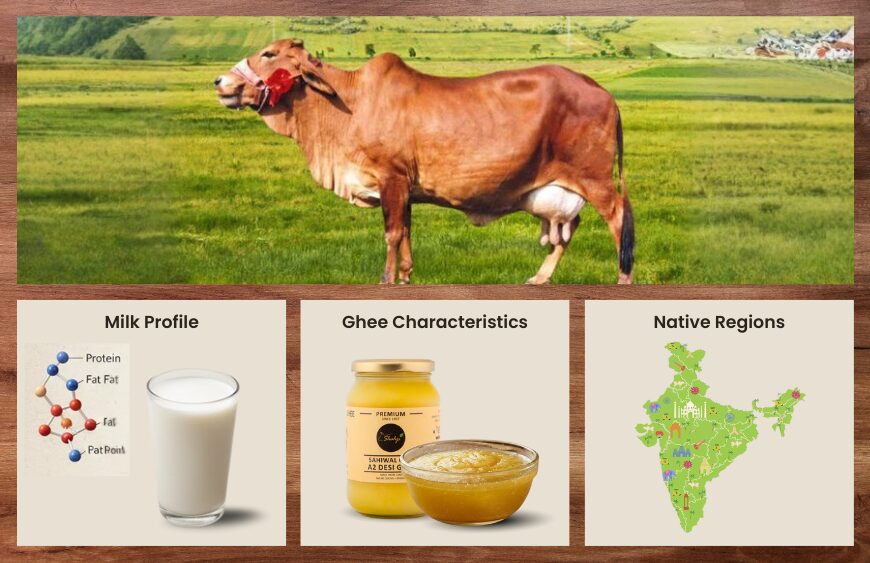
The Sahiwal cow originates from the Montgomery district (now Sahiwal district) of Punjab Province (now part of Pakistan), and surrounding areas in northwestern India.
Traditional Geography
- Punjab plains (before partition).
- Present-day Punjab, Haryana and western Uttar Pradesh
- Semi-arid regions with extreme summers
The climatic trait helped Sahiwal cow to be a heat-tolerant, disease-resistant, and reliable milk-producing breed, unlike breeds originating from hilly or forested areas.
Physical Characteristics of the Sahiwal Cow
The Sahiwal cow can be easily identified by its unique characteristics:
- The colour of the Sahiwal cow is a reddish-brown with a lighter underbelly.
- The Sahiwal cow has loose skin and a large dewlap.
- They have medium horns curving outward.
- The temperament of the Sahiwal is calm and have a strong maternal instincts.
Milk Yield and Lactation Profile
Unlike many indigenous breeds that generate a low volume of milk, the Sahiwal cow produces high volumes of milk and also provides high-quality milk on a steady basis.
Typical Milk Production
- On average: 8-12 litres/day
- Peak managed farms: up to 15 litres/day
- Lactation length: ~300 days
This balance makes Sahiwal ideal for small dairies and traditional ghee makers.
Milk Composition: Fat, Protein and A2 Beta-Casein
Fat Content
- Average milk fat: 4.5% – 5.5%
- Naturally higher solids-not-fat (SNF)
Protein Profile
- Contains A2 beta-casein protein
- Lower tendency to release BCM-7 peptide during digestion
This is one reason Sahiwal milk is often perceived as gentler on digestion compared to crossbred cows.
Why Sahiwal Milk Is Well-Suited for Ghee Making
Sahiwal milk is an ideal milk to produce high-quality Ghee because:
- It has well-balanced profiles of fatty acids.
- It results in high curd yield during fermentation.
- Maintains consistent aroma when heated slowly.
Traditional ghee makers like to use Sahiwal milk because it produces consistent results when prepared using the bilona process.
Ghee Characteristics from Sahiwal Cow Milk
Texture
- Semi-granular at room temperature.
- Smooth melting at lower temperatures.
Aroma
- Mild and nutty aroma.
- Less pungent than Gir Ghee.
- Much more aromatic than buffalo Ghee.
Colour
- Very pale golden to light yellow.
- Depends on fodder and season.
Flavor Profile- Every Day Use vs Occasional Use
Sahiwal ghee is often described as:
- Sahiwal ghee is well-balanced.
- It has a neutral flavorful profile.
- It is non-overpowering.
This makes Sahiwal ghee ideal for:
- Using in daily tadka
- Spreading on rotis and parathas
- Drizzling over hot rice
- Light traditional sweets
Digestibility and Daily Consumption
From a nutrition perspective, Sahiwal ghee:
- Contains short and medium-chain fatty acids.
- Melts easily at body temperature.
- Is suitable for regular consumption in moderation.
Unlike buffalo ghee, which is heavier, or Gir ghee, which can be intense for some individuals, Sahiwal ghee sits in the middle ground.
Sahiwal vs Gir vs Buffalo Ghee (Quick Comparison)
| Feature | Sahiwal | Gir | Buffalo |
|---|---|---|---|
| Taste | Balanced | Strong | Mild |
| Digestibility | High | High | Moderate |
| Daily Use | Excellent | Moderate | Limited |
| Fat Density | Medium | Medium | High |
Ghee According to Ayurveda Perspective
Classical Ayurveda values ghee that is:
- A Satvik source.
- Easily digested and assimilated.
- A suitable food for daily ahara.
While texts do not name breeds explicitly, practitioners prefer balanced cow ghee over heavy fats for long-term use — aligning well with Sahiwal ghee’s properties.
How to Identify Authentic Sahiwal Cow Ghee
- The breed should be clearly mentioned on the label.
- It should have single-origin sourcing.
- It should be mentioned that it is prepared using traditional bilona method.
- It must have an FSSAI license and batch traceability.
Shahji Sahiwal Cow Ghee
If you are looking to buy pure Sahiwal cow ghee made using the traditional bilona process, Shahji Sahiwal Cow Ghee is crafted in small batches from verified indigenous cows, with transparent sourcing, quality checks, and no additives or blending.

Frequently Asked Questions – FAQs
Is Sahiwal cow ghee A2?
Yes. Pure Sahiwal cows naturally produce A2 beta-casein milk.
Is Sahiwal ghee good for daily cooking?
Yes. Its balanced fat profile makes it suitable for daily Indian meals.
How is it different from Gir cow ghee?
Gir ghee is stronger in aroma and taste; Sahiwal ghee is milder and more neutral.
Can elders consume Sahiwal ghee regularly?
In moderate quantities, it is generally well-tolerated.
Is Sahiwal ghee suitable for children?
Yes, when used as part of a balanced diet.
Further Reading & References
This article is part of the Shahji Desi Ghee Knowledge Base, an ongoing effort to build India’s most reliable, research-aligned repository on desi ghee by combining:
- Indian regulatory standards and official definitions.
- Modern dairy science and analytical methods.
- Traditional breed and culinary knowledge.
- Nutrition science and balanced dietary context.
Official Standards & Laboratory Methods
- Food Safety and Standards Authority of India (FSSAI) – Food Safety and Standards Regulations – Milk and Milk Products; Fats & Oils
Provides the statutory definition of ghee, parameters for milk fat content, moisture limits and analytical constants like Butyro-Refractometer and Reichert–Meissl values. https://www.fssai.gov.in/upload/uploadfiles/files/Chapter%202_1%20%28Dairy%20Products%20and%20Analogues%29.pdf - FSSAI – Consolidated Food Product Standards
Official list of food product standards recognized by FSSAI, including dairy and ghee categories.
https://www.fssai.gov.in/cms/food-products-standards.php - FSSAI – Manual of Methods of Analysis: Milk & Milk Products / Dairy & Dairy Products
Detailed procedural manual used by laboratories, covering compositional and analytical methods for ghee (e.g., BR, RM, Polenske values).
https://www.fssai.gov.in/upload/uploadfiles/files/MILK_AND_MILK_PRODUCTS.pdf
Consumer Guides on Food Safety & Adulteration
- Ministry of Consumer Affairs – Consumer Product Testing Reports (Ghee)
Consumer product test reports that evaluate ghee quality and adulteration indicators under standard protocols.
https://consumeraffairs.nic.in/consumer-product-testing - FSSAI – Adulteration Online Learning Portal (DART resources)
Interactive & downloadable resources explaining rapid testing methods.
https://consumer.fssai.gov.in/learn
Dietary Guidelines & Health Context
- ICMR–National Institute of Nutrition (NIN) – Dietary Guidelines for Indians (2011 & 2024)
National dietary guidance recommending balanced use of visible fats (including ghee) as part of a wholesome diet.
https://www.nin.res.in/downloads/DietaryGuidelinesforNINwebsite.pdf - ICMR–NIN – Indian Food Composition Tables (IFCT)
Authoritative food composition dataset that includes detailed fat values for dairy, ghee and other Indian foods.
https://www.nin.res.in/IFCT_2017.pdf
Written by & Updated
Written by: Shahji Ghee Knowledge Team
Last updated: January, 2026
Related Articles

Grass Fed Ghee vs Grain Fed Ghee – What’s Better?

Best Ghee in India (2026): 14 Best A2 & Bilona Ghee Brands Compared
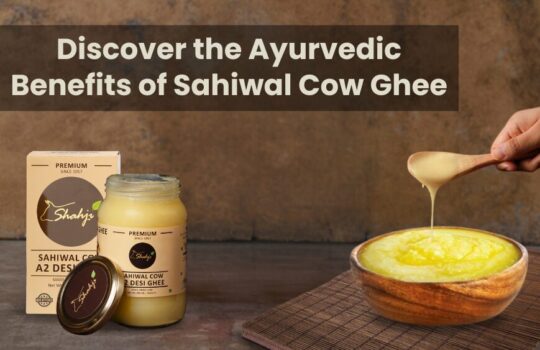
Sahiwal Cow Ghee in Ayurveda: An Ancient Superfood for Modern Living

Buffalo Ghee: A Nutrient-Rich Superfood for a Healthier Lifestyle