Bilona vs Cream Method: What Truly Changes in Your Ghee?

Introduction
In the modern world of “fast food”, the kitchen has become a place of efficiency. We have high-speed blenders, microwave ovens, and industrial food processing. But when it comes to Desi Ghee, speed is the enemy of nutrition.
If you’ve ever wondered why one jar of ghee costs ₹600 while another—costs significantly more, the answer lies in a 3,000-year-old wooden churner method called the Bilona Method.
In this guide, we explain you the two primary methods of ghee production and difference between them : the Modern Cream Method and the Traditional Vedic Bilona Method. By the end, you’ll understand exactly what happens to the molecular structure, the vitamins, and the “soul” of the ghee during these processes.
What is the Cream Method? (Industrial Mass-production )
Most ghee found on supermarket shelves today is produced by the Direct Cream Method or the Creamery Butter Method.
The Process:
- Centrifugation ( spinning ): Raw milk is put into large machines that spin at high speeds to separate the “cream” (malai) from the milk.These machines spin the milk at such intense speeds that the fat globules are forced to separate from the milk almost instantly. This bypasses the natural 12–18 hour resting period required for cream to rise or for curd to set. Because this happens so fast, the milk fat doesn’t have the time to bond with the natural enzymes and proteins that occur during slow fermentation.
- Direct Heating: This raw cream is then put into huge boilers and heated at high temperatures until the water evaporates and the fat separatesThese industrial boilers use high-pressure steam to reach temperatures often exceeding 120°C to 130°C.
- Shortcuts: Because the milk was never converted to curd i.e no fermentation involved therefore, it still contains high levels of raw lactose and casein. When heated at high speed, these proteins can “burn” rather than slowly caramelizing.Many industrial brands add artificial aromas or “ghee flavor” to mimic the smell of traditional ghee.
The Drawback:
Because the milk never turns into curd, it never undergoes fermentation. This means the lactose and casein remain largely untouched until the final heating stage. Furthermore, high-heat processing can degrade the delicate fat-soluble vitamins (A, D, E, and K).
What is the Bilona Method? (The Traditional Gold)
The word “Bilona” refers to the wooden churner used to whisk curd. The Vedic 5-Step Process, which treats ghee not as a commodity, but as a medicine.
Step 1: Boiling Milk

Fresh A2 milk from indigenous cows is boiled over a slow fire.This ensures the milk is safe and prepares the proteins for the next stage.
An indigenous cow refers to a native cattle breed that evolved in a specific region, like India’s Gir or Sahiwal, and is naturally adapted to local climates, diseases, and low-resource conditions, possessing traits like heat tolerance and hardiness.
Step 2: Fermentation ( Milk to Curd ) (The Game Changer)

This is where the two methods diverge. In the Bilona method, we do not use cream. Instead, the whole milk is converted into curd (Dahi) overnight. This forms beneficial bacteria and initiates the fermentation process. Fermentation breaks down lactose and proteins, making bilona ghee easier to digest and more gut-friendly.
Step 3: Churning (The Bilona)

The curd is then churned using a bi-directional wooden churner (Bilona). This is a slow, rhythmic process that separates the Makkhan (butter) from the curd Chaas (buttermilk).
Step 4: Separation

The Makkhan is hand-picked and washed. The remaining buttermilk is a nutrient-rich byproduct, but it is the butter that holds the “essence” of the real pure ghee.
Step 5: Slow Cooking

The Makkhan is placed in an earthen or heavy-bottomed pot and heated on a low flame. The slow heating allows the milk solids to settle gradually without burning, resulting in the granular (danedaar) texture ghee.
Bilona vs Cream Method
| Feature | Cream Method Ghee | Shahji Bilona A2 Ghee |
| Foundation | Raw Milk Cream | Cultured Curd (Dahi) |
| Fermentation | None | 12–18 Hours |
| Butyric Acid | Moderate | Very High |
| Vitamin K2 | Trace amounts | High (due to fermentation) |
| Digestibility | Can be heavy/bloating | Extremely light & gut-friendly |
| Lactose/Casein | May contain traces | 0% |
Why Fermentation Matters the Most
When milk turns into curd, the bacteria “pre-digest” the lactose and casein.This is why people with mild dairy sensitivities often eat Bilona Ghee without any issues, whereas Cream Ghee might cause them discomfort. Fermentation also creates Vitamin K2, which is essential for directing calcium to your bones instead of your arteries.
Sensory Comparison: Aroma, Texture, and Taste
If you have both types of ghee in your kitchen, try this test:
The Aroma Test
- Cream Ghee: Smells like butter or has a flat, oily feel.
- Bilona Ghee: Has a deep, nutty, and slightly caramelized aroma. The scent of real Bilona ghee can fill an entire house when a single spoon is added to hot dal.
The Texture Test (Danedaar)
- Cream Ghee: Often has a smooth, pasty, or “waxy” texture.
- Bilona Ghee: Features a distinct granular (Danedaar) texture. These tiny grains are a sign of slow-cooling and the presence of healthy fatty acid crystals
In Bilona ghee, the slow cooling allows fatty acid crystals to form naturally. In industrial ghee, rapid cooling leads to a smooth, waxy texture that lacks the of authentic Desi ghee.
The “Yield” Gap: Why Bilona is Pricier
To understand the price difference, look at the math:
- Cream Method: Uses machines to extract every drop of fat. It is highly efficient and requires less milk per kg of ghee.
- Bilona Method: It takes 25 to 30 liters of A2 Milk to produce just 1 kg of Shahji Bilona Ghee.
When you buy Bilona ghee, you aren’t paying for a “brand name”—you are paying for the 30 liters of premium milk and the days of labor that went into that single jar.
The Economics of Industrial Efficiency (Cream Method)
In the industrial Cream Method, the goal is 100% fat recovery. By using high-speed centrifuges, factories they can extract every microscopic globule of fat from the milk. This process is highly efficient and works with large volumes of “pooled milk”—often sourced from A1 hybrid cows or buffaloes, which have naturally higher fat percentages but lower nutritional values. Because the process is mechanized and takes only a few hours from milk to jar, the overhead costs are low. This creates a “commodity product” where the price is driven down by mass production, but the nutritional value is often sacrificed.
The 30-Liter Rule: The Bilona Math
In contrast, the Traditional Bilona Method is a lesson for patience and raw material density. To produce just 1 kilogram of Shahji Ghee – Pure A2 desi ghee , we require approximately 25 to 30 liters of pure A2 milk.
Why is the requirement so high?
- Selective Extraction: Unlike a centrifuge that forces fat out, the Bilona process relies on natural fermentation. When we turn 30 liters of milk into curd, and then churn that curd into butter, we are only keeping the “essence.”
- The “Chaas” Factor: A significant portion of the milk volume remains as nutrient-rich buttermilk (Chaas) after the churning process. We don’t “force” the fat out; we allow it to separate naturally.
- The Premium Purity: We only use A2 milk from indigenous Sahiwal and Gir cows. These cows produce less milk than hybrid breeds, but their milk is significantly richer in micronutrients and A2 beta-casein proteins.
You are Paying for Purity, Not Just a Label
When you invest in a jar of Shahji Ghee, you aren’t paying for fancy marketing; you are paying for the 30 liters of premium A2 milk and the 48 to 72 hours of manual labor that went into its creation. From the slow boiling to the overnight fermentation and the rhythmic bi-directional churning, the Bilona method is labor-intensive.
Choose Authentic Bilona Ghee Crafted the Traditional Way
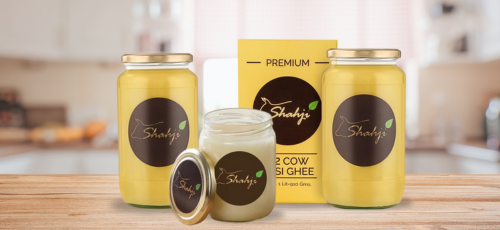
If you’re looking to experience true Bilona ghee, made exactly as described in this article, explore Shahji’s traditionally prepared A2 ghee range:
- Shahji A2 Gir Cow Bilona Ghee
Made using the 5-step Vedic Bilona process from Gir cow A2 milk. Ideal for digestion, immunity and everyday cooking.
https://shahjighee.com/product/a2-gir-cow-ghee
- Shahji A2 Sahiwal Cow Bilona Ghee
Prepared from Sahiwal cow milk, known for its rich fatty acid profile and superior taste. Perfect for Ayurvedic diets and families.
https://shahjighee.com/product/a2-cow-ghee - Shahji Murrah Buffalo Ghee
Made from the milk of Murrah buffalo milk, known for its rich and creamy flavour and texture. Perfect for traditional sweets and festive recipes.
https://shahjighee.com/product/buffalo-ghee
References
Official Standards & Scientific References
- FSSAI – Manual of Methods of Analysis (Milk & Milk Products)
Details laboratory methods for testing ghee quality including RM value, BR reading and adulteration markers.
https://www.fssai.gov.in/cms/manuals.php
Fermentation, Digestion & Fat Metabolism
- ICMR – National Institute of Nutrition (NIN)
Dietary Guidelines highlighting the role of traditional fats like ghee in moderation.
https://www.nin.res.in - Harvard T.H. Chan – The Nutrition Source (Fats & Oils)
Explains how fat processing and heat impact nutrient stability and digestion.
https://www.hsph.harvard.edu/nutritionsource
Frequently Asked Questions – FAQs
Is Bilona Ghee better for weight loss?
Yes. Because it is made via fermentation, it contains higher levels of CLA (Conjugated Linoleic Acid). CLA is known to help reduce body fat and improve lean muscle mass.
Does Bilona Ghee expire?
Pure Bilona ghee has a very low moisture content. If stored in a glass jar in a cool, dry place, it can last for 12–18 months without refrigeration. In fact, Ayurveda suggests that “Aged Ghee” (Purana Ghrita) has even higher medicinal properties.
Why is Shahji Ghee always A2?
Bilona is the process, but A2 is the source. By combining the A2 milk of Desi cows with the Bilona process, we ensure that you get a product that is 100% free from the A1 protein, which is linked to inflammation and digestive distress.
Conclusion: The Choice is Yours
The Cream Method is a triumph of industrial chemistry, but the Bilona Method is a triumph of nature and tradition. When you choose Shahji A2 Pure Cow Ghee, you are choosing a product that respects the cow, the process, and your body’s internal health.
It is an investment in your gut, your brain, and your long-term wellness.
Written by & Updated
Written by: Shahji Ghee Knowledge Team
Last Updated: January, 2026
Related Articles
Cultured Ghee vs Sweet Cream Ghee: Taste, Aroma and Health

Ghee Making Process: Step-by-Step Guide to Pure Ghee

What is the Bilona Method? Traditional Bilona Ghee Process Explained