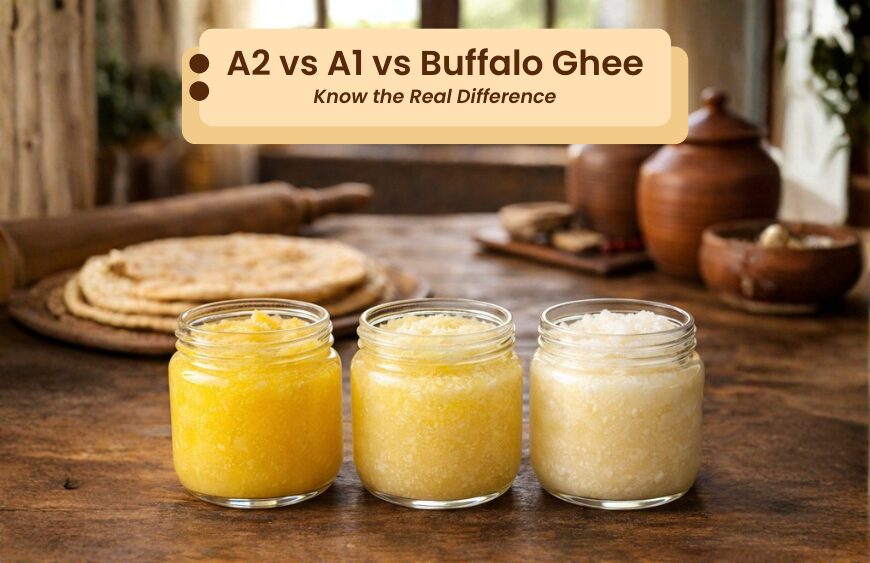
A2 vs A1 vs Buffalo Ghee: What’s the Real Difference?
Introduction
If you’ve shopped for desi ghee recently, you’ve probably seen labels like “A2 cow ghee”, “A2 Gir ghee”, “A2 Sahiwal ghee” – and then there is the familiar buffalo ghee your family may have used for decades.
Online, A2 is praised as “better”, “purer” or even “medicinal”. At the same time, some people warn that A1 milk and ghee are “dangerous”. It’s no surprise that many families are confused:
- Is A2 ghee really healthier than “normal” cow ghee?
- Is buffalo ghee A1 or A2?
- Should I pay extra for A2, or is it mostly marketing?
This guide breaks down A2 vs A1 vs buffalo ghee in a calm, practical way – what the terms actually mean, what science says so far, and how to decide what makes sense for your kitchen.
Who This Guide Is For
This guide will be especially useful for:
- Families deciding between A2 cow ghee, regular cow ghee and buffalo ghee
- Buyers confused by health claims around A2, BCM-7, “mutation”, etc.
- People who feel “heavy” or uncomfortable with some dairy and are wondering if A2 matters
- Retailers and health professionals who want a clear, non-sensational explanation
If you’ve already read “What Is Desi Ghee? A Complete Beginner’s Guide” in the Shahji Knowledge Base, this article builds on that foundation and goes deeper into milk types and proteins.
1. First, What Do “A1” and “A2” Actually Mean?
Before we compare ghees, we need to be clear:
A1 and A2 are about a milk protein, not about fat.
- Milk has several proteins; one of them is beta-casein.
- There are different versions (variants) of this beta-casein. Two major ones are A1 and A2.
- The difference between A1 and A2 is just one amino acid at a specific position in the protein chain.Wikipedia+1
Cows can have:
- Only A2 beta-casein (genotype A2A2) → their milk is often marketed as A2 milk
- A mix of A1 and A2 (A1A2)
- Mostly A1 (A1A1), more common in some European-origin breeds
When we say “A2 cow ghee”, we mean:
Ghee made from the milk of cows that produce only the A2 form of beta-casein.
The fat composition of the ghee (saturated/mono-unsaturated, etc.) does not magically change just because the casein protein is A2. The A1 vs A2 story is primarily about:
- How the protein is digested
- Whether certain peptides like BCM-7 get released in the gutPMC+1
2. Where Does Buffalo Ghee Fit In?
Here’s the part many people don’t know:
- Buffalo milk naturally carries only A2-type beta-casein in most studied populations.PubMed+1
So if you ask: “Is buffalo ghee A1 or A2?” the simple answer is:
Buffalo ghee is naturally A2-type in terms of beta-casein.
However, in the market, A2 marketing is mostly focused on cow milk and cow ghee, because:
- Cow breeds vary more (some lines are A1, some A2, some mixed)
- There is a commercial story around “indigenous A2 cow breeds”
Buffalo hasn’t needed a rebranding; it has quietly been “A2-type” all along.
3. What Does Science Say About A1 vs A2?
3.1 BCM-7 and the “milk hypothesis”
When A1 beta-casein is digested, it can release a peptide called beta-casomorphin-7 (BCM-7) in lab and animal studies. A2 beta-casein is less prone to releasing this peptide.PMC+1
Some early hypotheses and popular books claimed that A1 (and BCM-7) might be linked to serious conditions like type 1 diabetes, heart disease or neurological issues. This created a lot of anxiety – and a lot of A2 marketing.
However:
- The European Food Safety Authority (EFSA) did a detailed scientific review in 2009.
- They concluded that available data was not sufficient to establish a cause-and-effect relationship between BCM-7 intake and non-communicable diseases.PMC+2PMC+2
In simple terms:
Serious disease claims around A1 milk are not proven at population level.
3.2 Digestion and comfort – a more realistic area
More recent human studies and reviews have looked at digestive comfort:
- Some small trials report that people who experience digestive discomfort with regular milk feel less bloating or discomfort with A2-only milk, especially in sensitive individuals.ScienceDirect+2ScienceDirect+2
- Other research emphasizes that results are not uniform and sample sizes are small.
So a balanced summary is:
- A2 milk may feel gentler on the stomach for some people who struggle with regular milk.
- Evidence is still evolving, and it is not correct to say “A1 is poison, A2 is medicine”.
For ghee, keep in mind:
- Ghee is almost pure fat, with very little protein left.
- Whatever A1/A2 protein story exists in milk is much smaller in ghee simply because the casein content is tiny.
That’s why large official bodies focus more on total fat intake and type of fat rather than A1 vs A2 when giving dietary guidelines.efi.org.in+4ICMR National Institute of Nutrition+4ICMR National Institute of Nutrition+4
4. What Stays the Same in All Ghees (A2, A1, Buffalo)
Under Indian food law, ghee is defined by its fat and quality parameters, not by A1/A2 claim.
FSSAI standards broadly require that:FoSCoS+3FSSAI+3FSSAI+3
- Ghee must be made only from milk or milk products
- Milk fat content must be extremely high (almost all fat)
- Moisture and free fatty acids must be within specific limits
- No added non-milk fat is allowed
Whether it’s:
- A2 Gir cow ghee
- A2 Sahiwal cow ghee
- Regular mixed-breed cow ghee
- Buffalo ghee
…they all must meet the same basic legal definition of ghee.
What changes is:
- Milk type & breed (A2 cow vs mixed cow vs buffalo)
- Flavour and aroma
- Colour and texture
- Price and marketing story
- How your own body feels when you eat it
5. Practical Differences: A2 Cow Ghee vs “Regular” Cow Ghee vs Buffalo Ghee
5.1 A2 Cow Ghee (e.g., Gir, Sahiwal)
Common characteristics:
- Milk from indigenous breeds with mostly A2A2 genotype (e.g., Gir, Sahiwal).livestockscience.in+1
- Colour often rich golden/yellow, depending on feed.
- Usually small-scale, more traceable sourcing.
- Price per kg is typically higher due to breed, yield and marketing.
Who tends to choose it:
- Households who want to support native breeds and traditional systems
- People who feel uneasy with regular milk but tolerate A2 better and want to extend that choice to ghee
- Buyers seeking very specific terroir-based flavours (Gir vs Sahiwal etc.)
5.2 Regular Mixed Cow Ghee
Usually:
- Comes from mixed or crossbred cows, often with A1/A2 combination.
- Still regulated as ghee; still mostly milk fat.
- Available at a more accessible price point.
- Quality depends heavily on the producer’s honesty, process and testing, not just on A1/A2.
Who tends to choose it:
- Households that are price-sensitive but still want real ghee
- People with no specific sensitivity to dairy proteins
- Buyers in urban areas buying from large dairies or co-ops
5.3 Buffalo Ghee
Key traits:
- Naturally A2-type beta-casein in most buffalo populations.PubMed+1
- Colour often pale cream to white; texture can feel denser.
- Flavour is rich and slightly different from cow ghee – some sweets taste especially good with buffalo ghee.
- Common in many North Indian households and halwai traditions.
Who tends to choose it:
- Families used to the flavour from childhood
- Cooks making specific dishes (certain mithai, tandoori items, parathas)
- Buyers who want a strong, rich mouthfeel
6. Is A2 Ghee “Healthier” Than A1 or Buffalo Ghee?
This is the big question everyone asks. The honest answer is:
We don’t have definitive proof that A2 ghee is universally “healthier” for everyone than other real ghee.
From a health-science perspective:
- Fats (including ghee) are energy-dense; guidelines consistently say: use in moderation.efi.org.in+4ICMR National Institute of Nutrition+4ICMR National Institute of Nutrition+4
- The overall diet, physical activity, and medical profile matter far more than the A1/A2 label alone.
- A2 may make sense for people who feel better with A2 milk, but this is a personal response, not a universal rule.
If you have specific medical conditions (heart disease, high cholesterol, diabetes, etc.), your doctor or dietitian should guide total ghee intake and overall fat pattern, regardless of whether it is A2 or not.
7. Common Myths About A2, A1 and Buffalo Ghee
Myth 1: “A2 ghee is automatically medicinal and can be eaten in any quantity.”
Reality:
- A2 ghee is still ghee – energy-dense and rich in fat.
- Overeating any ghee (A1 or A2, cow or buffalo) can be a problem for some people.
- Quality + quantity + overall diet > single label.
Myth 2: “Buffalo ghee is ‘bad’ and only cow ghee is real ghee.”
Reality:
- Buffalo ghee has been used in Indian homes and sweets for generations.
- Its beta-casein profile is A2-type, but the texture and taste are different.PubMed+1
- Many traditional recipes actually prefer buffalo ghee for richness.
Myth 3: “If it says A2, it must be automatically pure and honest.”
Reality:
- A2 describes a protein type, not a full guarantee of purity.
- You still need to check:
- Source transparency
- Method (curd → makhan → ghee, etc.)
- Lab testing for adulteration
- Brand reputation and consistency
A2 + poor process is still poor ghee.
Non-A2 + excellent process and honest testing is still good ghee.
Myth 4: “Switching from A1 to A2 will cure all health issues.”
Reality:
- Health outcomes rarely depend on one switch.
- Some people report better digestive comfort with A2 milk; others don’t notice a huge difference.ScienceDirect+2ScienceDirect+2
- Lifestyle, stress, sleep, total diet, other conditions – all matter.
8. How to Decide: A2 Cow Ghee vs Buffalo Ghee vs Regular Cow Ghee
Instead of asking “Which is the best for everyone?”, use these questions:
- How does your body feel?
- If milk with A1 makes you uncomfortable but A2 milk feels better (under medical guidance), A2 cow ghee may feel psychologically or personally more aligned.
- What does your family actually eat?
- Do you use small amounts daily?
- Or larger amounts in sweets and heavy dishes?
- For many households, a mix of cow and buffalo ghee for different dishes is perfectly reasonable.
- What is your budget?
- A2 Gir/Sahiwal ghee will be more expensive.
- Paying extra only makes sense if:
- You value the breed/sourcing story, and/or
- You feel a difference and can comfortably afford it.
- What do you trust about the producer?
- Clear sourcing and testing
- No unrealistic health claims
- Transparency about method and batches
9. Product Bridge: How Shahji Approaches A2 Cow and Buffalo Ghee
Understanding A2, A1 and buffalo ghee is not just theory. It should help you choose better jars in real life.
Different households prefer different combinations:
- Some use A2 Gir or Sahiwal cow ghee as their main daily ghee.
- Some keep buffalo ghee for specific dishes and sweets.
- Some prefer a more accessible cow ghee option that is still clean and honestly produced.
At Shahji, our focus is on:
- Traditional processes (curd → makhan → ghee) for our A2 range
- Clear distinction between A2 cow ghee variants (e.g., Sahiwal, Gir) and buffalo ghee
- Emphasis on testing, traceability and flavour, not miracle claims
If you are exploring A2 and buffalo options side by side:
Use this article to frame your choice: think about taste, budget, trust and your own health context, not just labels.
10. Further Reading & References
This guide is part of the Shahji Desi Ghee Knowledge Base, which combines traditional Indian wisdom, dairy science and modern nutrition guidelines.
If you haven’t already, you may also want to read:
- What Is Desi Ghee? A Complete Beginner’s Guide
- How to Identify Pure Desi Ghee
- Cooking with Desi Ghee: Everyday Uses and Recipes
Official Standards and Definitions for Ghee (India)
- Food Safety and Standards Authority of India (FSSAI)
Food Safety and Standards (Food Products Standards and Food Additives) Regulations, 2011 – Dairy Products and Analogues
Official Indian legal definition of ghee, including minimum milk fat content, moisture limits, and purity standards, issued by India’s national food regulator.
🔗 https://www.fssai.gov.in/upload/uploadfiles/files/Chapter%202_1%20%28Dairy%20Products%20and%20Analogues%29.pdf - FSSAI – Consolidated Food Product Standards
Comprehensive FSSAI compendium covering regulatory standards and classifications for dairy products, including ghee, butter oil and milk fats.
🔗 https://www.fssai.gov.in/cms/food-products-standards.php
A1/A2 Beta-Casein and BCM-7 Scientific Literature
- European Food Safety Authority (EFSA)
Review of β-casomorphins, β-casein and related peptides (2009)
Authoritative scientific review concluding that available evidence does not establish a cause-and-effect relationship between BCM-7 consumption and major non-communicable diseases.
🔗 https://www.efsa.europa.eu/en/efsajournal/pub/231 - Ul Haq, M.R., Kapila, R. & Kapila, S.
Release of β-casomorphin-7 from A1 β-casein in cow milk: A physiological perspective
Peer-reviewed review discussing digestion of A1 vs A2 beta-casein and BCM-7 release mechanisms.
🔗 https://www.ncbi.nlm.nih.gov/pmc/articles/PMC3215354/ - Brooke-Taylor, S. et al.
Systematic review of the gastrointestinal effects of A1 versus A2 beta-casein
Review summarising human trials comparing digestive responses to A1 and A2 milk protein variants, showing mixed but evolving evidence.
🔗 https://www.frontiersin.org/articles/10.3389/fnut.2017.00028/full
Indian Dietary Guidelines and Fat Consumption
- Indian Council of Medical Research – National Institute of Nutrition (ICMR-NIN)
Dietary Guidelines for Indians (2011, updated editions)
India’s national dietary guidelines recommending balanced fat intake, including traditional fats like ghee, in moderation as part of a healthy diet.
🔗 https://www.nin.res.in/downloads/DietaryGuidelinesforNINwebsite.pdf - ICMR-NIN
Indian Food Composition Tables (IFCT)
Authoritative nutritional composition reference used by researchers, dietitians and public health institutions across India.
🔗 https://www.nin.res.in/IFCT_2017.pdf
References are provided for educational purposes and reflect the current state of scientific and regulatory understanding. Readers should consult qualified healthcare professionals for personalised medical advice.
11. Frequently Asked Questions (for On-Page & Schema)
You’ll use these both in the article and in Rank Math FAQ schema.
1. Is A2 ghee healthier than A1 ghee?
There is no definite proof that A2 ghee is universally healthier for everyone. A2 refers to a beta-casein variant in milk protein. Some studies suggest A2 milk may be better tolerated by certain individuals with digestive discomfort, but major health agencies have not declared A1 milk unsafe. Total ghee quantity, overall diet and existing health conditions matter more than the label alone.
2. Is buffalo ghee A1 or A2?
Buffalo milk, and therefore buffalo ghee, is generally A2-type in terms of beta-casein. Studies show that buffaloes predominantly carry the A2A2 genotype, which means their milk does not contain the A1 variant that is discussed in the A1/A2 debate. However, buffalo ghee still needs to be consumed in moderation like any other fat.
3. Should I switch to A2 ghee if I have digestion issues with dairy?
If you experience discomfort with regular milk, your doctor or dietitian may sometimes suggest trying A2 milk as an experiment. A2 ghee might feel more reassuring to you in that context, but remember that ghee itself contains very little protein compared to milk. Any switch should be made under medical guidance, especially if you have diagnosed allergies, lactose intolerance or other gut conditions.
4. Is A2 ghee lactose-free?
During ghee making, most water and milk solids, including lactose, are removed. Many people with mild lactose sensitivity tolerate ghee better than milk. However, trace amounts may remain, and ghee is not guaranteed lactose-free for people with severe lactose intolerance or milk protein allergy. When in doubt, consult your doctor.
5. Is A2 ghee worth the higher price?
It depends on what you value. A2 ghee often comes from specific indigenous breeds and smaller, more traceable supply chains, which increases cost. If you appreciate the breed story, feel better with A2 milk, or simply prefer the flavour and can comfortably afford it, the premium may make sense. If not, good quality cow or buffalo ghee from a trustworthy producer is also a valid choice.
6. Which ghee is best for heart health: A2 cow, regular cow or buffalo?
From a heart-health perspective, what matters more is total saturated fat intake, overall dietary pattern, physical activity and medical supervision, not just A2 vs A1. All ghees are rich in fat. People with heart disease, high cholesterol or diabetes should follow personalised advice from their cardiologist or dietitian about how much and what type of fat to use.
7. How can I know if ghee is genuinely A2?
Look for:
- Clear mention that the ghee comes from A2A2-tested cows
- Information on breeds (e.g., Gir, Sahiwal)
- Third-party lab reports or test summaries
- A brand that avoids extreme health claims and focuses on transparency
Even with A2, checking purity, process and testing is just as important as checking the label.
Written by & Updated
Written by: Shahji Ghee Knowledge Team
Last Updated: December, 2025
Related Articles

What Happens Inside Your Body When You Eat Ghee – Digestion & Metabolism

What Is Desi Ghee? A Complete Beginner’s Guide

Ghee vs Vegetable Oil: The Healthier Fat
Ghee vs Refined Oil: Best Pick for Daily

How Much Ghee Per Day? Daily Limit by Age and Diet Type