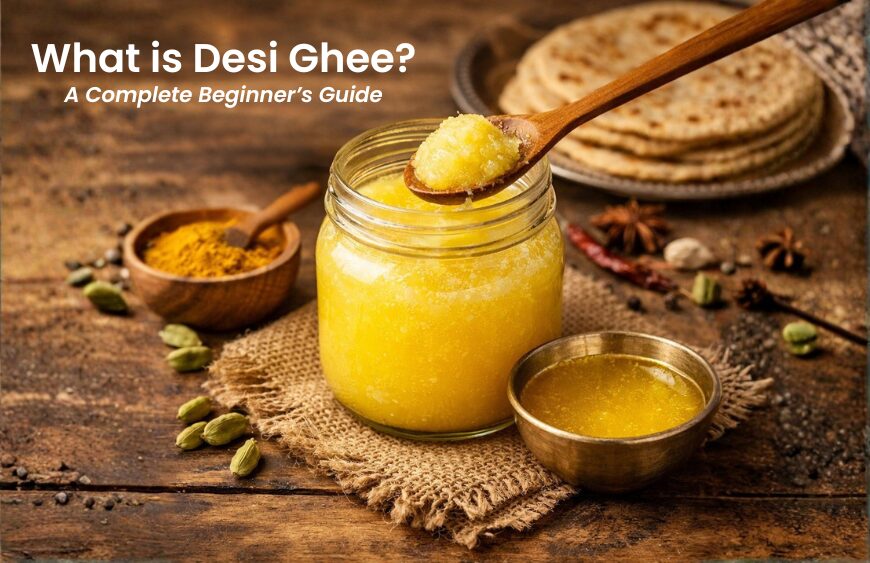
What Is Desi Ghee? A Complete Beginner’s Guide
Introduction
If you grew up in an Indian home, you’ve seen desi ghee on the dining table, in sweets, on hot rotis, in tadkas, and even in home remedies. But if someone asked you, “What exactly is desi ghee?” you might still hesitate.
Is it just clarified butter?
Is A2 ghee the “real” ghee?
Is it healthy or harmful?
This guide is a clear, practical answer to the question “what is desi ghee” – from how it is made and how it differs from other fats, to how it behaves in your body and how to start using it sensibly in daily life.
Who This Guide Is For
This beginner-friendly guide on desi ghee is especially useful for:
- People who are new to desi ghee and want a clear, unbiased explanation
- Families considering a shift from refined oils or butter to ghee
- Buyers confused by terms like A2, bilona, cow ghee and buffalo ghee
- Anyone who wants to understand ghee beyond marketing claims and myths
If you already use ghee but want deeper clarity on what makes it “desi”, how it is traditionally made, and how it fits into daily life, this guide will give you a strong foundation.
What Is Desi Ghee?
At its simplest, desi ghee is clarified fat made from milk – usually cow or buffalo – where the water and milk solids have been removed, leaving behind almost pure milk fat.
But in the Indian context, “desi ghee” means more than that:
- It is often made from fermented dairy (curd), not just fresh cream
- It is linked to indigenous breeds of cows and buffaloes
- It carries cultural, ritual and Ayurvedic significance
- It has a specific aroma, flavour and texture that people associate with “ghar ka ghee”
So a practical definition is:
Desi ghee is traditional Indian clarified milk fat, usually made from curd or cream, with a characteristic nutty aroma and granular texture, used in cooking, rituals and health practices.
Not every clarified butter in the world qualifies as “desi ghee”. The method, source and context matter.
How Is Desi Ghee Traditionally Made?
There are two main traditional routes to making desi ghee. Both start from milk but differ in how they handle fermentation and cream.
1. Curd → Makhan → Ghee (Bilona-style logic)
This is the method people commonly associate with “bilona ghee” or “traditional ghee”.
Step 1 – Milk → Curd
- Fresh milk is boiled and cooled to a warm temperature.
- A small amount of starter curd (jaaman) is added.
- The milk is left to set into curd (dahi).
Step 2 – Curd → Cultured Buttermilk & Butter (Makhan)
- The curd is churned, traditionally with a wooden bilona or churning rod.
- Churning separates:
- White butter (makhan)
- Cultured buttermilk (chaas)
Step 3 – Makhan → Ghee
- The white makhan is collected and slowly heated.
- The remaining water evaporates.
- Milk solids brown at the bottom.
- The fat turns golden and aromatic – this is ghee.
- The ghee is filtered and stored.
This method often gives:
- Rich aroma
- Slightly tangy, deep flavour (because of the fermented curd)
- A pleasant granular texture when set
2. Cream → Butter → Ghee
This is common in many homes and dairies too.
Step 1 – Cream from Milk
- Milk is boiled and cooled.
- The malai (cream) layer is collected over days.
- The collected cream is stored chilled.
Step 2 – Cream → Butter
- The cream is churned or shaken to separate:
- Butter
- Buttermilk
Sometimes this cream is also slightly fermented.
Step 3 – Butter → Ghee
- The butter is heated to remove water and brown the milk solids.
- The golden fat obtained is ghee.
This method can produce excellent ghee too, though flavour and texture may differ from curd-based ghee.
What Actually Happens During “Clarification”?
When you heat butter or makhan:
- Water evaporates → the ghee becomes shelf-stable
- Milk proteins & sugars (like lactose) separate and brown at the bottom
- The fat becomes:
- More heat-stable for cooking
- Longer shelf life
- More aromatic
This process is what makes ghee different from simply melted butter.
How Is Desi Ghee Different from Butter and Oil?
Many people ask: “Why use ghee when I can use refined oil or butter?”
Let’s keep it simple and practical.
Ghee vs Butter
Butter:
- Contains:
- Water
- Milk solids
- Milk sugar (lactose)
- Has a lower smoke point – burns more easily
- Has a shorter shelf life without refrigeration
Desi Ghee:
- Almost pure milk fat (water & most solids removed)
- Has a higher smoke point → more stable at many Indian cooking temperatures
- Is naturally shelf-stable at room temperature if kept clean and dry
- Has a different, nutty aroma and flavour
That’s why ghee is often preferred for:
- Tadka (tempering)
- Sautéing at reasonable heat
- Long storage in Indian conditions
Ghee vs Refined Vegetable Oil
Refined oils (like many neutral-tasting seed oils) may go through processes such as:
- Solvent extraction
- Bleaching
- Deodorization
They are designed to be:
- Cheap
- Neutral in taste
- Easy to use in bulk
Their health impact depends on the type of fat, processing and overall diet.
Desi ghee, when made properly, is:
- Made from milk fat only
- Produced by heat clarification, not solvent extraction
- Linked to traditional cooking patterns and portion sizes
Neither is a “magic health food” or instant poison. The difference lies in:
- How much you use
- What else you eat
- How active you are
- Your overall health context
Ghee vs Vanaspati / “Dalda”
It’s crucial to separate real desi ghee from vanaspati (hydrogenated fat).
- Vanaspati is usually made from vegetable oils that are hydrogenated to make them solid.
- It is cheaper and sometimes used to imitate ghee in commercial foods.
- It is not the same as desi ghee in source, process or behaviour in the body.
When we discuss the place of ghee in Indian diets, we are talking about real desi ghee, not vanaspati.
Types of Desi Ghee (By Milk Source)
When people ask what is desi ghee, they often also mean “which desi ghee?”.
Broadly, most desi ghee falls into these buckets:
Cow Ghee
- Made from cow’s milk
- Colour: usually golden to yellowish (varies by breed & feed)
- Aroma: often more pronounced
- Texture: can be softer at room temperature
- Strongly linked to religious and traditional practices
Within cow ghee, you’ll hear terms like:
- Indigenous breeds (e.g., Sahiwal, Gir, etc.)
- Crossbred cows
- A2-labelled products (related to milk protein type)
We’ll explore these distinctions in dedicated articles.
Buffalo Ghee
- Made from buffalo milk
- Colour: often pale to creamish (can appear whiter)
- Texture: can feel slightly denser
- Taste: rich mouthfeel, often preferred in certain regions and sweets
Buffalo ghee is very common in many parts of North India and has its own place in traditional cooking.
A2, A1 and Labelling
Labels like:
- A2 Cow Ghee
- A2 Gir Cow Ghee
- A2 Sahiwal Ghee
relate to types of beta-casein protein in the milk (A1 vs A2). It’s a nuanced topic needing its own deep dive.
The key point for beginners:
- A2 is a milk protein story, not a complete guarantee of purity, process or honesty
- Even A2 ghee should be evaluated on:
- Sourcing transparency
- Method of preparation
- Lab testing
- Taste & aroma
- How your body responds
We’ll cover A2 vs A1 vs buffalo ghee properly in a separate guide.
How Does Desi Ghee Behave in Your Body?
Desi ghee is mainly:
- Fat (mostly saturated and monounsaturated fatty acids)
- Contains some natural fat-soluble vitamins (like A, D, E, K – amounts depend on milk, feed and processing)
Digestion and Energy
- Ghee provides concentrated energy.
- Some of the fats in ghee are relatively easily absorbed and used by the body for energy.
- Traditional Indian diets often used small amounts of ghee to:
- Enhance satiety
- Make dry foods easier to chew and swallow
- Improve mouthfeel and enjoyment of meals
Heat Stability
Because of its composition and how it is made, ghee has a relatively high smoke point compared to many unrefined cooking fats.
This means:
- It can handle many Indian cooking techniques (tadka, sautéing) without breaking down as quickly as some other fats, when used at reasonable temperatures.
As with any fat, extremely high, repeated heating is not advisable.
Ghee and Health: Big Picture View
The real question is rarely “Is ghee good or bad?”, but:
How much, for whom, in what context, and within what overall diet and lifestyle?
Factors that matter:
- Total daily fat intake
- Presence of other fats (oils, fried foods, ultra-processed items)
- Physical activity levels
- Existing health conditions (heart disease, diabetes, etc.)
- What else is eaten with the ghee (fresh, whole foods vs heavily processed)
Many traditional and modern nutrition perspectives point towards a balanced approach:
- Use good quality ghee
- Use it in moderation, as part of a balanced diet
- For specific medical conditions, especially heart disease, high cholesterol or diabetes, always discuss with your doctor or dietitian before making major changes
This article is meant to educate, not prescribe.
Common Myths and Misunderstandings About Desi Ghee
Myth 1: “Ghee is automatically healthy if it’s A2.”
Reality:
- A2 describes a type of milk protein
- Health impact depends on many factors, not just the label
- Overeating any fat, A2 or not, can still cause problems in some people
- Process, quality, and portion size still matter
Myth 2: “More ghee = more health.”
Reality:
- Ghee is calorie-dense
- For many people, small, regular amounts are more suitable than large, occasional doses
- Your body, lifestyle and medical profile must guide quantity
Myth 3: “If ghee is grainy, it is always pure.”
Reality:
- Grainy texture can be a sign of certain cooling and production conditions
- It may indicate traditional-style preparation, but
- It is not a foolproof purity test
- Lab tests and reliable sourcing are more trustworthy than single visual tests
Myth 4: “Only cow ghee is ‘real’ ghee.”
Reality:
- Buffalo ghee has been used in many Indian homes for generations
- Both cow and buffalo ghee have a place in traditional diets
- Choice depends on:
- Taste preference
- Local availability
- Cooking style
- Cultural habits
How to Start Using Desi Ghee in Daily Life (Beginner Guidelines)
If you’re new to desi ghee or switching from other fats, here are simple starting points:
1. Replace, Don’t Just Add
Instead of adding ghee on top of everything else, consider:
- Replacing part of:
- Refined oil used on rotis
- Butter used on toast
- Oil used in tadka
with a sensible amount of ghee.
2. Use Ghee Where It Truly Shines
Good use cases:
- Tadka for dals and sabzis
- On hot rotis, parathas, bajra/jowar rotis
- Over hot steamed rice with salt and simple sides
- In traditional sweets that are meant to use ghee
3. Listen to Your Body
- Notice how you feel after switching some fats to ghee
- Observe:
- Digestion comfort
- Energy levels
- Taste satisfaction
- If you have health issues, track your numbers with your doctor’s guidance.
4. Focus on Quality and Honesty
No definition of “what is desi ghee” is complete without talking about trust:
- Sourcing: Where does the milk come from?
- Process: How is it churned, heated, tested?
- Transparency: Are lab results or quality checks explained?
Ghee is not just a product; it is trust in a jar.
Frequently Asked Questions About Desi Ghee
1. Is desi ghee the same as clarified butter?
All ghee is a form of clarified butter, but not all clarified butter is desi ghee.
Desi ghee refers to traditional Indian ghee, usually:
- Made from Indian-style curd or cream
- Prepared with specific heating and cooling patterns
- Used in Indian cultural, culinary and health contexts
2. How much desi ghee can I eat in a day?
There is no one-size-fits-all answer.
It depends on:
- Age
- Activity level
- Total diet pattern
- Existing health conditions
Many nutrition experts give broad ranges (for example, 1–2 teaspoons to 1–2 tablespoons per day for some adults), but this is not a prescription.
If you have heart disease, high cholesterol, diabetes or other conditions, please check with your doctor or dietitian.
3. Is desi ghee lactose-free?
During the ghee-making process, most of the:
- Water
- Milk solids
- Milk sugar (lactose)
are removed.
Many people with mild lactose sensitivity tolerate ghee better than milk or butter. However:
- Traces may remain
- People with severe allergies or lactose intolerance should be cautious and consult their doctor.
4. Why does my ghee look different in different seasons?
Ghee is sensitive to:
- Temperature – it may be more solid in winter and more liquid in summer
- Storage conditions – exposure to heat, sunlight or moisture
- Milk source – feed, breed and season can change fat composition
Colour and texture differences do not automatically mean impurity.
5. Does real desi ghee always have a strong smell?
Not necessarily.
- Some traditional ghees have a pronounced roasted aroma
- Others are milder, depending on:
- Milk source
- Heating stage
- Method
Extremely artificial smells or perfume-like notes are suspicious, but natural variation is normal.
6. Is desi ghee suitable for children and the elderly?
Traditionally, small amounts of good quality ghee have been used for:
- Children (for energy and food palatability)
- Elders (to soften dry foods and aid swallowing)
However:
- Quantities should be modest
- Overall diet and medical conditions matter
- For specific health issues, always seek medical guidance
7. What is the simplest definition of desi ghee I can remember?
You can think of it this way:
Desi ghee is traditional Indian clarified fat made from cow or buffalo milk, with water and milk solids removed, used both as a cooking fat and as a culturally important food in Indian kitchens.
A Note on Choosing Authentic Desi Ghee
Understanding what desi ghee really is helps you make better, more informed choices as a consumer. Beyond labels and claims, factors like milk source, preparation method, consistency, aroma, and transparency around testing matter far more in the long run.
Different households prefer different types of ghee depending on taste, cooking style, and tradition. Some lean towards cow ghee for everyday use, while others prefer the richness of buffalo ghee for certain dishes.
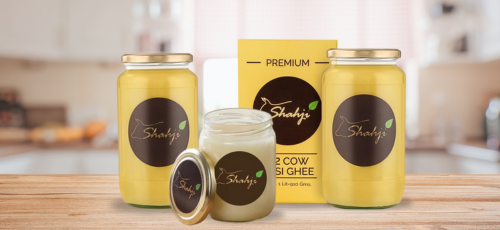
At Shahji, we prepare desi ghee using traditional processes and focus on clarity around sourcing, method, and quality checks for each variant we offer.
→ Explore Shahji’s Cow and Buffalo Desi Ghee Collection
Further Reading & References
This article is part of the Shahji Desi Ghee Knowledge Base, which brings together traditional Indian culinary knowledge, basic dairy science, and modern nutritional understanding.
Readers interested in going deeper may explore:
Official Standards and Definitions for Ghee (India)
- Food Safety and Standards Authority of India (FSSAI)
Food Safety and Standards (Food Products Standards and Food Additives) Regulations, 2011 – Dairy Products and Analogues
This regulation defines “Ghee” under Indian law, including quality parameters such as milk fat content, moisture limits, and purity standards.
🔗 https://www.fssai.gov.in/upload/uploadfiles/files/Chapter%202_1%20%28Dairy%20products%20and%20analogues%29.pdf - FSSAI – Consolidated Food Product Standards
Official compendium published by FSSAI covering definitions, classifications, and standards for all regulated food products in India, including milk fats and ghee.
🔗 https://www.fssai.gov.in/cms/food-products-standards.php - FSSAI Manual of Methods of Analysis – Milk & Milk Products
This document outlines the laboratory methods officially accepted by FSSAI to test ghee quality and authenticity.
🔗 https://www.fssai.gov.in/upload/uploadfiles/files/MILK_AND_MILK_PRODUCTS.pdf
Indian Dietary Fat & Nutrition Research References
- Indian Council of Medical Research (ICMR) – National Institute of Nutrition (NIN)
Dietary Guidelines for Indians
Authoritative guidelines on dietary fat intake in Indian diets, issued by India’s apex nutrition research body.
🔗 https://www.nin.res.in/downloads/DietaryGuidelinesforNINwebsite.pdf - National Institute of Nutrition (ICMR-NIN)
Indian Food Composition Tables
Official reference for nutritional composition of Indian foods and fats, used in public health and academic research.
🔗 https://www.nin.res.in/IFCT_2017.pdf - Peer-reviewed Research – Ghee and Lipid Profile
The effect of ghee (clarified butter) on serum lipid levels (Journal of Ayurveda and Integrative Medicine)
A scientific study examining ghee consumption in the Indian context and its metabolic effects.
🔗 https://pmc.ncbi.nlm.nih.gov/articles/PMC3215354/
Classical Ayurvedic Texts & Traditional Literature on Ghee
- Charaka Samhita
One of Ayurveda’s foundational texts, describing ghee (Ghrita) as a daily dietary fat and a carrier for nourishing and therapeutic preparations. - Sushruta Samhita
Ancient Ayurvedic treatise discussing ghee’s role in diet, recovery, and rejuvenation practices. - Comprehensive Review of Ghee in Ayurveda and Modern Science
Health benefits of ghee: A review of Ayurveda and modern science
This review collates references from multiple classical Ayurvedic texts spanning more than 3,000 years.
🔗 https://pmc.ncbi.nlm.nih.gov/articles/PMC10789628/ - Systematic Review – Ghrita (Ghee) in Ayurveda
Academic review summarizing traditional Ayurvedic references and comparing them with modern nutrition science.
🔗 https://www.researchgate.net/publication/336330691
Related guides from the Shahji Knowledge Base (as they go live):
- A2 vs A1 vs Buffalo Ghee: What’s the Real Difference?
- How to Identify Pure Desi Ghee
- Cooking with Desi Ghee: Everyday Uses and Recipes
Written by & Updated
Written by: Shahji Ghee Knowledge Team
Last Updated: December, 2025
Related Articles

What Happens Inside Your Body When You Eat Ghee – Digestion & Metabolism
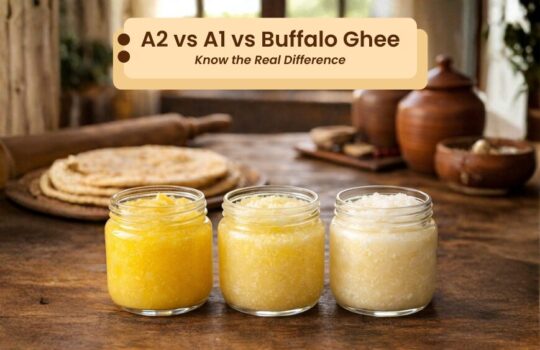
A2 vs A1 vs Buffalo Ghee: What’s the Real Difference?
Ghee vs Vegetable Oil: The Healthier Fat
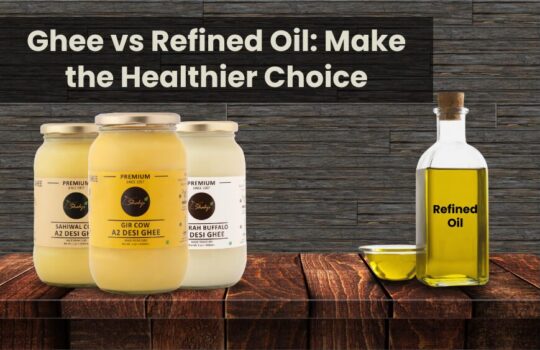
Ghee vs Refined Oil: Best Pick for Daily

How Much Ghee Per Day? Daily Limit by Age and Diet Type